Sunday, March 10th, 2019 (
No comments yet)
Sunday, March 10th, 2019 (
No comments yet)
Sunday, March 10th, 2019 (
No comments yet)
Now the terrorist watch list is making it to our everyday lives.

Private businesses such as rental and mortgage companies and car dealers are checking the names of customers against a list of suspected terrorists and drug traffickers made publicly available by the Treasury Department, sometimes denying services to ordinary people whose names are similar to those on the list.
…
Yet anyone who does business with a person or group on the list risks penalties of up to $10 million and 10 to 30 years in prison, a powerful incentive for businesses to comply.
…
"It prohibits anyone from doing business with anyone who's on the list. It does not have a minimum dollar amount. . . . The local deli, if it sells a sandwich to someone whose name appears on the list, has violated the law."
This might be a good thing if it actually worked. Judging on how the no-fly list works, I'm guessing it doesn't.
So what happens when the terrorists start using names like:
- John Smith
- Mike Brown
- Chris Anderson
- Mary Jones
- Beth Miller
Tags:
Big Brother,
Big Business,
Treasury Department,
Watch Lists
Saturday, March 9th, 2019 (
No comments yet)
In an act of supreme stupidity and ignorance, Washington state has passed a law allowing residents to purchase an "alternative" drivers license that could be used in lieu of a passport at the Canadian border.
Citing the 9/11 Commission's support for more secure documentation for U.S. entry, Chertoff pointed out that U.S. Customs and Border Protection agents currently must look at more than 8,000 different forms of identification, whether birth certificates, driver's licenses or other documents.
So their answer to the problem?
The alternative license will contain a Radio Frequency Identification chip, commonly known as RFID, which the guard booths will use to scan the license as a traveler or trucker pulls up to the booth. U.S. passports issued since late 2006 already contain RFID chips.
They're going to offer a license that has no shielded covers like passports do that border guards will now just non-chalantly swipe across a reader rather than take the time to inspect. Brilliant. Maybe next, they can just put the readers out for the people in the vehicle to use making it even more convenient. That way, the criminals wouldn't have to bother changing the photo on the ID since no one would be looking anyway.
Tags:
Big Brother,
RFID,
State ID,
Washington State
Friday, March 8th, 2019 (
No comments yet)
According to the Washington Post, the FBI issued thousands of national security letters many without any clear ties to "emergencies" or current investigations.
Referring to the exigent circumstance letters, Sen. Charles E. Grassley (R-Iowa) wrote in a letter Friday to Justice Department Inspector General Glenn A. Fine: "It is . . . difficult to imagine why there should not have been swift and severe consequences for anyone who knowingly signed . . . a letter containing false statements. Anyone at the FBI who knew about that kind of wrongdoing had an obligation to put a stop to it and report it immediately."
No kidding. What I don't get is why everyone is saying that the "FBI's use of the exigency letters "circumvented" the law" rather than just say "They broke the law and many of the buggers are going to jail".
Tags:
Big Brother,
FBI,
George Bush
Friday, March 8th, 2019 (
No comments yet)
Friday, March 8th, 2019 (
No comments yet)
Idaho has joined a growing trend of states that are flat out telling the federal government to jump off a cliff. The REAL ID act has been attacked by privacy organizations for being a national ID card which will have far reaching implications to personal freedom. Not only that, but implementation of the system is extremely expensive and each state is supposed to pay for it.
Tags:
Big Brother,
George Bush,
Idaho,
Real ID,
Security Theater
Friday, March 8th, 2019 (
No comments yet)
Bruce Shneier says it better, with more sources, but the FBI is abusing it's powers to circumvent the subpeona process.
The Justice Department's inspector general has prepared a scathing report criticizing how the F.B.I. uses a form of administrative subpoena to obtain thousands of telephone, business and financial records without prior judicial approval.
Tags:
Big Brother,
FBI,
George Bush
Thursday, March 7th, 2019 (
No comments yet)
Spychips author Katherine Albrecht has warned of RFID being put into things like paper, clothing, stamps etc. and it looks like the technology is
catching up with the theory.
Also this excerpt from Popular Science explains it in more detail actuallly referencing the use of these RFID chips in money.
For years, radio-frequency identification, or RFID, tags have been used to track everything from highway tolls to pets, but only Hitachi’s newest tag is skinny enough to fit inside a dollar bill. Just 0.15 millimeter square and 7.5 microns thick, it’s a mere 1/15 the size of the next smallest RFID chip. And it can do everything its predecessors can. Hitachi’s tags store up to 128 bits of data—including prices, serial numbers and places of origin—that radio scanners can read from more than 10 feet away.
RFID chips typically use thick metal guard rings to insulate their circuitry. The insulation limits electrical interference but makes the tags too bulky for thin products such as paper. Hitachi’s weight-loss solution is to remove the rings and separate the circuits into individual wells coated with a thin insulating layer of silicon dioxide.
So far, the new insulation trick has worked perfectly. An earlier version of the chip successfully debuted in tickets for the 2005 World Exposition in Aichi, Japan, as a way to stop counterfeiters, and a new, even slimmer version could appear in European and Japanese currency within the next few years. When that happens, banks and businesses can simply scan the tagged bills to confirm their authenticity or trace their origins.—Elizabeth Svoboda
Tags:
Big Brother,
Big Business,
RFID
Thursday, March 7th, 2019 (
No comments yet)
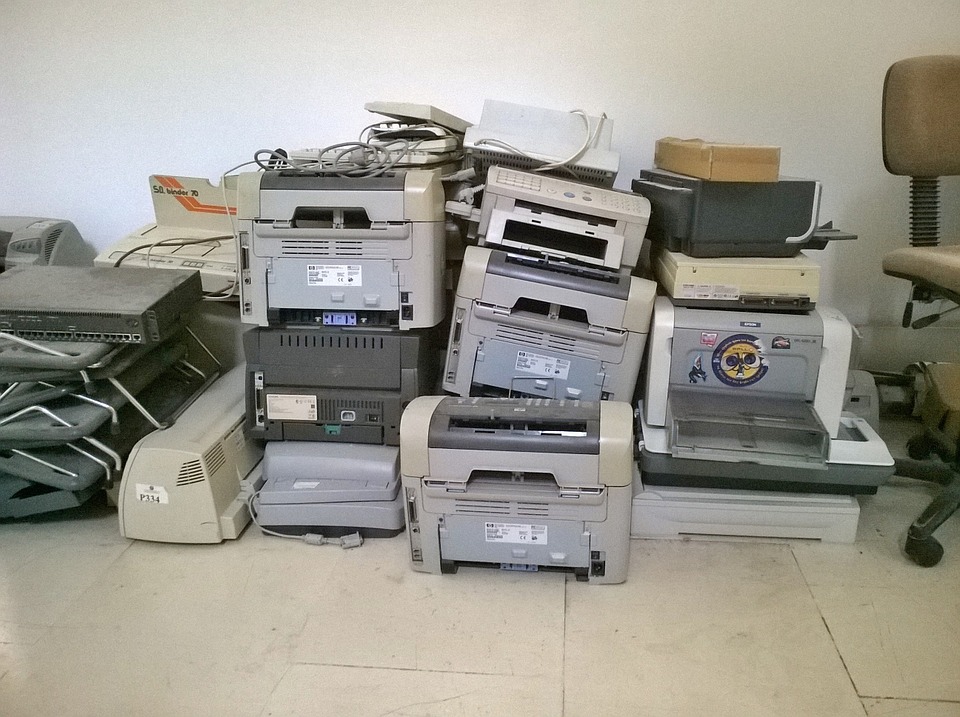
Did you know that many new printers print "tracking dots" that encodes information in everything you print? They are nearly invisible, but can be used by law enforcement or others to specifically identify what printer printed any photo or document.
Since they don't openly disclose this "feature", be sure to stop by the EFF's guide to which printers come with tracking dots and which don't before you choose your next printer.
Tags:
Big Brother,
Big Business,
Tracking Dots