Friday, June 4th, 2010 (
No comments yet)
As depressing as the privacy and security landscape gets around here, sometimes our European friends come out with laws that make us seem so much better by comparison.
While everyone knows child porn is a very bad thing, some people will use that to push big brother agendas that are way worse than the crime they try to prevent! But won't you please think of the children!?
Remember folks, perfect society is easily obtained! Just remove all privacy and freedom from EVERYONE and we'll easily be able to weed out the bad guys at any time. Sweet!
Tags:
European Union,
Internet
Wednesday, March 20th, 2019 (
No comments yet)
Apparently Yahoo! is set to publicize everything you do online to all your friends. If you're not excited about this thrilling change, you can opt out with a single button click (so they say), but it doesn't say where or how.
I logged in with an old account and here's what you're looking for:
Once you click that, here's what you'll see:
Click the checkbox and you should be good until the next major settings change they hope you don't notice.
Note that I clicked around a bit and eventually I did get a screen that warned me about the change and let me opt out. Even if you see that screen, it's not a bad idea to follow the directions I listed above just in case. Anyway, here's what the alert looked like:
Make sure to uncheck each box here the click "Get Started"
Tags:
Internet,
Yahoo
Wednesday, March 20th, 2019 (
No comments yet)
While I don't support downloading music and movies instead of buying them, I also don't support abusing the legal system to bully people and make money. The RIAA has been doing just that for a long time according to several consumer groups.
In this case, the The American Civil Liberties Union - ACLU and the The Electronic Frontier Foundation (EFF) are arguing that when the The RIAA - Who They Are In a Nutshell sues thousands of "infringers", they have to file thousands of separate lawsuits and not just one.
Filing one is cheaper and easier, but makes it harder and is unfair for the victims… er, I mean defendants.

If the court adopts the approach suggested here, the costs of the current anti-P2P litigation strategy could become untenable. If each anonymous defendant requires several hundred dollars in filing fees, individual paperwork, individual subpoenas, and detailed information on their alleged distribution, settling for a mere $1,500 doesn't sound so hot.
Let's hope for the best. Leave people alone and worry about pirating organizations and criminal groups instead.
Source: Ars Technica
Tags:
ACLU,
Big Business,
EFF,
Filesharing,
Good Stuff,
P2P,
RIAA
Wednesday, March 20th, 2019 (
No comments yet)
In a move that has most people saying "huh?", Google launches SSL search capability! By adding HTTPS to the front of your bookmark or homepage like so: https://www.google.com, you will be using Google's new service.
This is the same as Google's normal search engine with a few important differences:
- Searches are encrypted from your browser to Google. While Google still knows who you are and everything you search for, anyone between you and them no longer will (thus the magic of HTTPS). So now when you're on the road (cafe, hotel, airport etc), the people who run or are listening to that network traffic won't be able to see what you search for or what results Google sends back.
- Any results you click will not forward a "Referrer" value. Normally, when you click a link, the page you visit gets to see where you just came from (called the referrer value). Since the page you came from was a Google search and the search terms are part of the URL, every page you visit gets to see the terms you used to find them. Google SSL removes that keeping your search terms private from websites you visit.
Combine this with the "private" browsing functions of all major Internet browsers and you'll leave little to no record of anything you search on your computer or the networks in-between. It still doesn't solve the problem of Google recording your search history against your will, but it's a great start!
Note that only web search and not others (like image search) are secured at this time, but Google may be looking to add those in the future.
Tags:
Good Stuff,
Google,
HTTPS,
Internet,
Search Engines,
SSL
Wednesday, March 20th, 2019 (
No comments yet)
One of the many problems of RFID technology is that they can be hacked and used to spread viruses.
The device, which enables him to pass through security doors and activate his mobile phone, is a sophisticated version of ID chips used to tag pets.
In trials, Dr Gasson showed that the chip was able to pass on the computer virus to external control systems.
If other implanted chips had then connected to the system they too would have been corrupted, he said.
Mostly, this hasn't received a lot of attention to date because the computing power of RFID has historically been very low. But as the technology progresses, the consequences of not securing them properly becomes higher and higher.
Tags: RFID, Spychips
Thursday, March 21st, 2019 (
No comments yet)
I don't want this page to descend into an "everything about Facebook" page, but the news has been coming fast and hard the last few weeks. The article I found today isn't news, but instead a plea to the public to not buy in to Facebook's apology for their recent nastiness.
Parents of young children can spot an insincere apology from miles away.
"Sorry," your tot mumbles, after you find the dog half-shaved and your Xbox full of jam.
"Sorry for what?" you'll say. "Sorry for shaving the dog and putting jam in your Xbox," he'll say, looking at the floor. But he's lying. He's only sorry that he didn't get away with it.
Facebook's much-reported apology in the Washington Post is a bit like that. "Sorry," says Mark Zuckerberg. "Sorry for what?" the internet asks.
"Sorry for invading your privacy and making things confusing and stuff," Zuckerberg says. "Can I have an ice cream now?"
Funny and blisteringly accurate; that's a good combination. Check out the rest of the article here
Tags:
Facebook,
Internet,
Lies and Damned Lies
Thursday, March 21st, 2019 (
No comments yet)
It looks like it didn't take long for them to get the hint. Facebook will now be improving their privacy controls and policy.
From the CNN article:
Tech blogger Robert Scoble... equated the privacy outrage to both Facebook's complicated privacy settings and the company's inability to communicate why users should share their private information with the public.
No kidding. Well now Mark Zuckerberg has admitted to making some mistakes and promises to do better. We'll see.
Tags:
Facebook,
Mark Zuckerberg
Thursday, March 21st, 2019 (
No comments yet)
Facebook has found itself facing some tough choices when it comes to the direction of the company, specifically revolving around user privacy. As most Netizens know, Facebook has faced harsh criticism in recent months—which may be coming to a head after having built up slowly over the years—regarding how it handles user information. Now, the company is left deciding whether it wants to revert to its old principles and go against founder Mark Zuckerberg's policy of forging ahead, privacy be damned.
Also this:
Luckily, there are now third-party tools that help users patch up their Facebook settings, such as the incredibly helpful bookmarklet from Reclaim Privacy that lets users see what their settings are and change them automatically. These tools shouldn't be necessary, however.
The Reclaim Privacy tool is very easy to use and effective too! I haven't checked the code personally to see if it's safe, but my virus scanner didn't blip at all and I have nothing in my profile that I'm worried about sharing publicly so there was little risk. Also, since the tool is completely open-source, I'm willing to bet that someone somewhere has taken the time to look it over and would have raised a flag by now.
The author could change the code at any time, but I suspect he's legitimately trying to build attention to his website and isn't looking to quickly become tossed aside by adding attack code. Still, use at your own risk.
Lastly:
It's unlikely that such a user-friendly utopia will arrive anytime soon, though, especially given Zuckerberg's now-legendary disregard for privacy. That said, Zuckerberg was the one who called last week's company meeting to discuss the current state of Facebook privacy and user trust, so it's possible that he's beginning to warm to the idea of giving users what they want.
Source: http://arstechnica.com/tech-policy/news/2010/05/facebook-privacy-comes-to-a-head-changes-may-be-imminent.ars
If you don't know what they mean by recent privacy issues, check out these:
Facebook Secretly Adds Applications to Your Profile
10 Reasons to Quit Facebook
Finding a Name For Bully Data Practices Leads to Facebook
Senators Send Angry E-mail to Facebook Over Privacy Changes
Facebook Forces Users to Display Hometown, Work, Interests
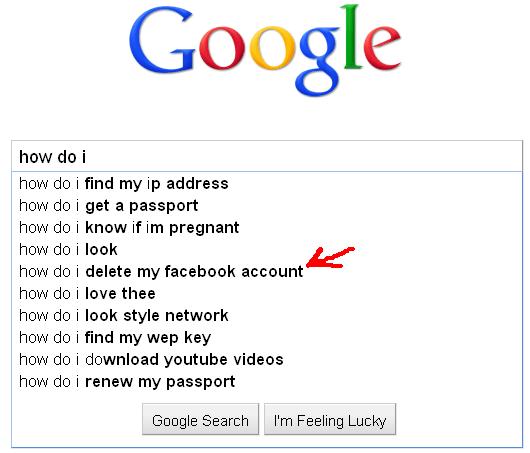
Maybe it's because of things like that that led to this interesting result being found as a top result for Google's suggest feature:
Tags:
Facebook
Thursday, March 21st, 2019 (
No comments yet)
Thursday, March 21st, 2019 (
No comments yet)
Wow. It seems like the last week or so, all I've talked about is Facebook! But it seems there's an awful lot to talk about! Check out what I found today:
If you visit certain sites while logged in to Facebook, an app for those sites will be quietly added to your Facebook profile. You don't have to have a Facebook window open, you don't need to signed in to these sites for the apps to appear, and there doesn't appear to be an option to opt-out anywhere in Facebook's byzantine privacy settings.
According to the source article, Facebook contacted them and told them it was a bug that has been fixed. That's the second such bug this week.
Tags:
Facebook,
Internet,
Social Networking